How to Do a Pull-Up: From Zero to Your First Rep
By Anna · Updated November 2026 · 9 min read
The pull-up is the one bodyweight exercise that separates people who train from people who go to the gym. It also has the highest barrier to entry of any common movement: it requires lifting your entire body weight with your upper back, which is a ratio most adults cannot reach straight away. That is not a reason to skip it. It is a reason to follow a progression instead of trying and failing.
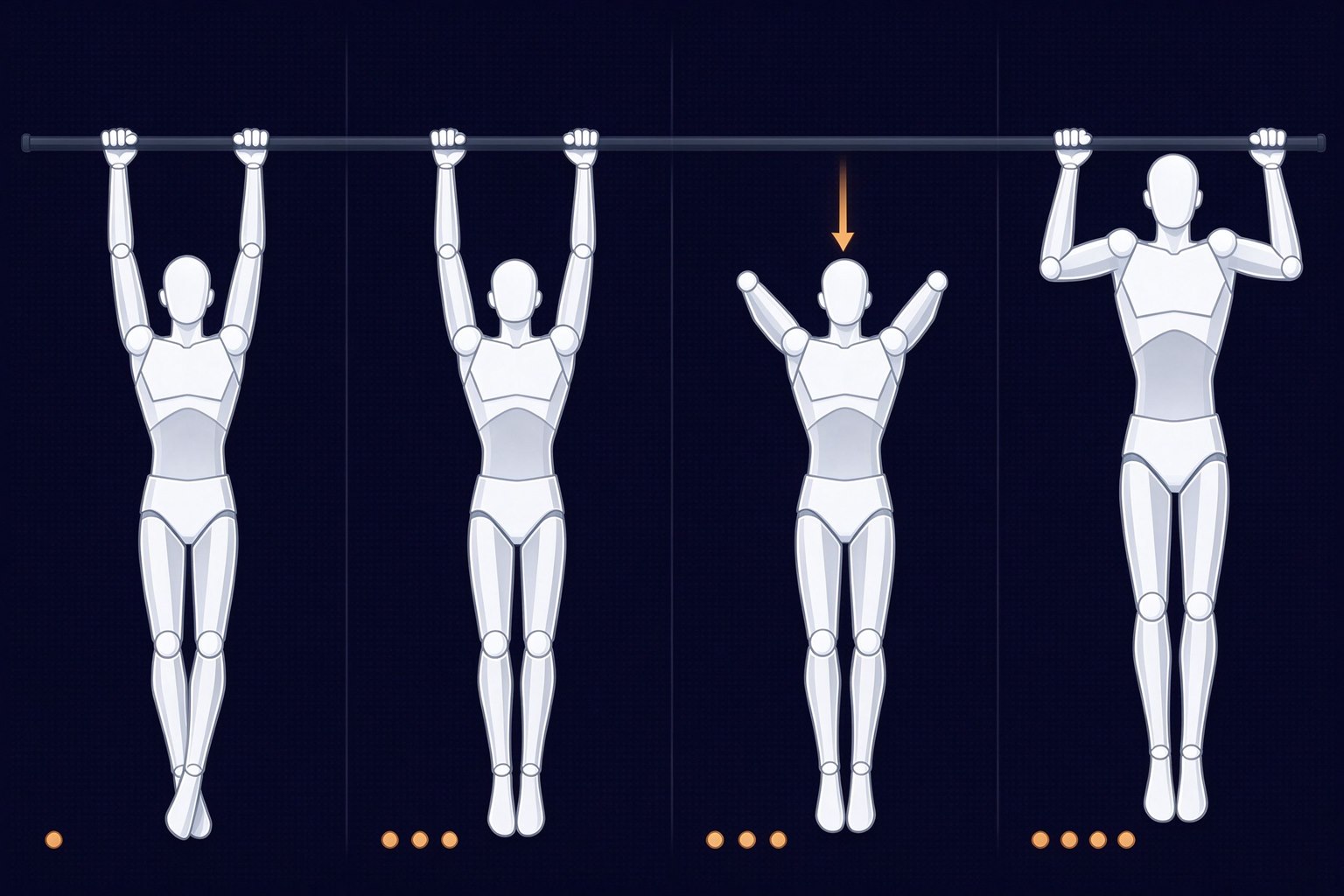
Step 1: The dead hang
Before you can pull, you have to be able to hang. Grip the bar with palms facing away, hands slightly wider than shoulder width. Hang with straight arms and your feet off the floor. Start with ten seconds and build to thirty. Do this three times per session for two weeks.
The dead hang trains your grip, stretches your lats, and teaches your shoulders to accept load at full extension — which is the single most common weak point. If you cannot hang for twenty seconds without your grip failing, that is where you are, and that is fine. Nobody starts further along.
Step 2: Scapular pull-ups
Hang from the bar with straight arms. Without bending your elbows at all, pull your shoulder blades down and together, which lifts your body two or three inches. Hold one second, then relax back into the hang. Three sets of eight.
This is the movement most people are missing. When you feel "I cannot feel my back working" in a pull-up, it is because the shoulder blades never depressed — the arms did all the pulling. Scapular pull-ups teach that first inch, which is the hardest and most important inch of the whole rep.
Step 3: Negatives
Jump or step up so your chin is above the bar, then lower yourself as slowly as you can — aim for five seconds on the way down, and stop when your arms are straight. Three to five reps, three times a week.
Negatives work because the eccentric (lowering) phase of a muscle contraction is where you are strongest — you can resist about 30% more load on the way down than you can lift on the way up. That means negatives let you train the exact movement at a load you cannot yet lift. When you can do five negatives of eight seconds each, your first full rep is usually two to four weeks away.
Step 4: Band-assisted and the first rep
Loop a resistance band around the bar and under one knee or foot. The band takes off weight at the bottom, where you are weakest, and gives almost no help at the top, where you are strongest. That is the opposite of a machine, and it is why bands work better. Reduce band thickness over weeks until you are doing single reps with the thinnest band, then try one unassisted.
| Week | What you do | Target |
|---|---|---|
| 1–2 | Dead hangs + scapular pull-ups | 20 sec hang, 3×8 scapular |
| 3–5 | Add negatives, keep hangs | 3×5 negatives at 5 sec |
| 6–8 | Band-assisted reps, thick band | 3×5 with thick band |
| 9–11 | Thinner band, fewer reps | 3×3 with thin band |
| 12+ | Single unassisted attempts, then doubled reps | 1 rep → 2 reps |
Technique cues for the rep itself
- Start from a full hang. Arms straight, shoulders relaxed but not shrugged up to your ears. A half-rep from a bent-arm start trains almost nothing.
- Shoulder blades first, elbows second. Pull your blades down before you bend your arms. This is the cue that makes the back do the work.
- Think "elbows to hips." Not "chin over bar." Driving your elbows down and back keeps your chest up and stops you from kipping or swinging.
- Keep your legs quiet. Cross your ankles and squeeze your glutes so your body does not swing. Any momentum means the rep does not count for training purposes.
- Lower with control. Do not drop. Every rep ends with a controlled descent back to a full hang.
If you cannot do a pull-up yet, train these instead
While you work the progression above, your back still needs volume. Swap pull-ups for rows and lat pulldowns. The five-day plan and the hypertrophy plan both include substitutions for every pull. At home with nothing but a doorway, a towel row under a table and a backpack row cover the same pattern — see the at-home equipment swaps.
Frequently asked questions
How long until my first pull-up?
Eight to twelve weeks for most people training three times a week. Four to six months is normal for women and heavier lifters, because the relative strength needed is higher.
Pull-ups or chin-ups first?
Chin-ups. The palms-facing grip lets the biceps help, which makes it easier for nearly everyone. Move to pull-ups once you can do three chin-ups.
Do assisted pull-up machines work?
They work, but the assistance is constant, so the hardest part of the range gets the least specific training. Bands and negatives are generally better for a first rep.
Why can't I feel my back?
Because the shoulder blades are not depressing before the elbows bend. Practise scapular pull-ups until that first inch is automatic.
Written by
Anna
Yoga & Pilates instructor since 2010, Fitness Yoga Level 6, postnatal recovery specialist. Full credentials →