Postpartum Workout Routine: A Safe Return to Training
By Anna · Updated November 2026 · 11 min read
This is the one page on this site where I write from the training I actually did rather than from general principles. I completed the postnatal recovery therapy programme at the Ladi International Yoga Academy in 2018 and have taught recovery classes since. What follows is the sequence I use with my own clients — and it is deliberately slower than what most fitness apps will tell you.
Read this first. This page is general education, not medical advice. Do not start any of it until your doctor has cleared you at your postnatal check (usually six weeks after a vaginal delivery, eight to twelve after a caesarean). If you have pelvic pain, heavy bleeding, leaking urine, a feeling of heaviness in the pelvis, or a gap you can feel down the middle of your abdomen, see a pelvic health physiotherapist before starting.
Why the order matters more than the exercises
Pregnancy stretches and loads the abdominal wall, the pelvic floor and the diaphragm all at once. After birth, those three structures need to learn to work together again before they can take load. If you jump straight to squats, planks or running, the pressure your core cannot manage gets transferred downward to the pelvic floor. That is the mechanism behind the leaking, heaviness and lower-back pain that so many women are told is simply "normal after a baby."
So the sequence is: breathe → reconnect → load → build. Each phase overlaps with the next, but you do not skip ahead. Most of my clients spend six to eight weeks on the first two phases, and that is not slow — it is the fastest route to being able to train properly again.
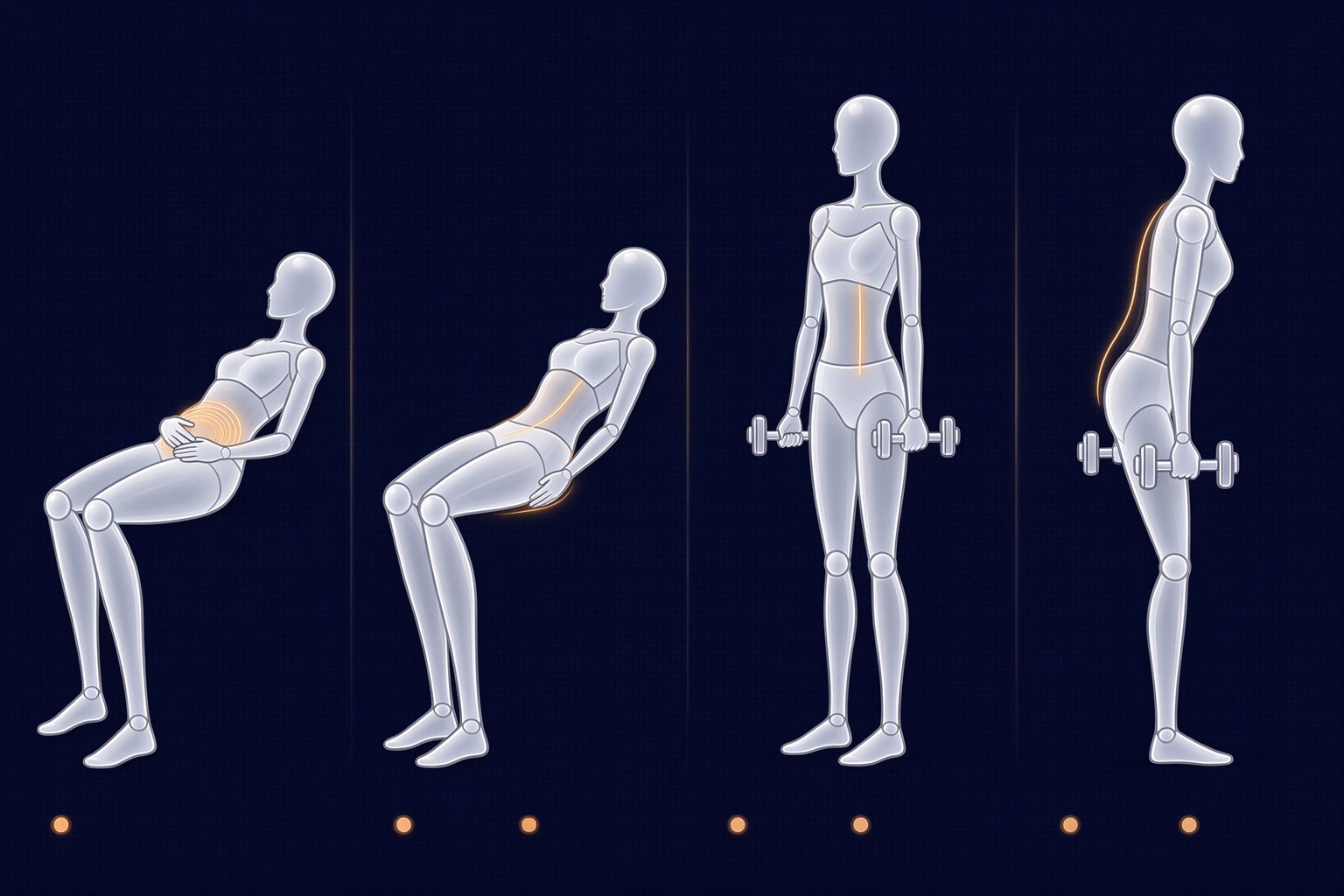
Phase 1: Breathing (weeks 0–6, once cleared)
Everything starts with the breath, because the diaphragm is the top of your core cylinder and the pelvic floor is the bottom. When they move together, pressure is managed. When they do not, it is not.
| Exercise | How | Dose |
|---|---|---|
| 360° breathing | Lie on your back, hands on your lower ribs. Breathe in and feel your ribs widen sideways and your belly soften, not your chest lift. | 5 breaths, 3× a day |
| Pelvic tilt | Gently rock your pelvis toward your heels, then toward your ribs. Small range, no forcing. | 8–10 slow reps |
| Pelvic floor lift | On the exhale, gently draw up from the pelvic floor as if stopping wind and urine at once. Hold 3 seconds, release fully. The release matters as much as the lift. | 8–10 reps |
| Heel slides | Lie on your back, knees bent, feet flat. Slide one heel out until your leg is straight, keeping your back still. Return. | 8 each side |
Phase 2: Reconnection (weeks 4–10)
Now you add gentle load to the deep core while keeping the breath pattern. The goal is to feel your lower abdomen engage without your ribs flaring or your back arching.
- Dead bug. Lie on your back, knees over hips at 90 degrees. Exhale as you extend one arm and the opposite leg, keeping your lower back flat to the floor. 2 sets of 6 each side.
- Glute bridge. Feet flat, knees bent, lift your hips by squeezing your glutes — not by arching your back. 2 sets of 10.
- Bird dog. On hands and knees, extend one arm and the opposite leg. Do not let your hips rotate. 2 sets of 6 each side.
- Side-lying clamshell. Lie on your side, knees bent, lift the top knee without rolling your hips back. 2 sets of 12.
- Pallof press. With a light band, press straight out from your chest and resist the pull that wants to rotate you. 2 sets of 8 each side. This is the single best anti-rotation core exercise and it is safe for almost everyone.
Walking is your cardio through both phases. Start with ten minutes, add five a week up to thirty. Do not run yet. Running generates roughly two to three times your body weight in impact per stride, and until your pelvic floor can manage that, it will not.
Phase 3: Load (weeks 8–12 onward)
Once breathing and core control are automatic — meaning you can do a dead bug set without your back arching or your ribs flaring — you can start adding external load. Begin with the patterns that support the body rather than those that load the midline.
| Add first | Add later | Avoid until cleared |
|---|---|---|
| Goblet squat | Romanian deadlift | Crunches, sit-ups, V-ups |
| Dumbbell row (supported on a bench) | Dumbbell bench press | Heavy back squats |
| Hip thrust | Lat pulldown | Running, jumping, box jumps |
| Split squat (bodyweight) | Overhead press | Heavy conventional deadlifts |
| Cable or band row | Leg press | Anything that makes you leak |
Symptom rule: leaking urine, heaviness in the pelvis, or a bulging feeling in the abdomen means the load is too much right now — drop back a phase, not just a weight.
A three-day starting week
When you are ready for structured sessions, this is what I start clients on. Twice through, plus a fourth day of walking if you feel good.
| Session | Content | Time |
|---|---|---|
| A | Breathing 2 min → dead bug 2×6 → glute bridge 2×10 → goblet squat 2×8 → supported dumbbell row 2×8 → Pallof press 2×8 each | 25 min |
| B | Breathing 2 min → bird dog 2×6 → clamshell 2×12 → split squat 2×8 each → hip thrust 2×10 → side plank from knees 2×20 sec | 25 min |
Run A, B, A in week one. If you are sore for more than two days or leaking at all, repeat the same week rather than progressing. Progression is adding a set, not adding weight, for the first month.
When to see a professional
Please book a pelvic health physiotherapist if any of these apply: leaking urine when you cough, sneeze or lift; a feeling of heaviness or dragging in the vagina; pain during sex; a visible doming or ridge down the middle of your abdomen when you sit up; separation wider than two fingers; or diastasis that has not changed after eight weeks of consistent work. None of these are things to train through alone.
Frequently asked questions
When can I start exercising after giving birth?
After your postnatal check and your doctor's clearance — around six weeks for an uncomplicated vaginal delivery, eight to twelve weeks after a caesarean. Breathing and pelvic floor work can usually begin earlier with guidance.
Does diastasis recti mean I cannot exercise?
No, but it changes the order. Rebuild breathing and deep core control first, and avoid loaded flexion and high impact until a physiotherapist confirms the gap is closing.
Can I do sit-ups?
Not in the early months. Crunches load the midline exactly where the separation is. Use dead bugs and Pallof presses instead, and reintroduce flexion only once cleared.
When can I run again?
When you can walk 30 minutes briskly, do 20 single-leg calf raises each side, and jump on the spot ten times without leaking or feeling heaviness. Most women reach that somewhere between three and six months, and that is normal.
Written by
Anna
Completed postnatal recovery therapy training at Ladi International Yoga Academy (2018). Yoga & Pilates instructor since 2010, Fitness Yoga Level 6. Full credentials →